
Mobility for Martial Artists: Sensible Rather Than Extreme
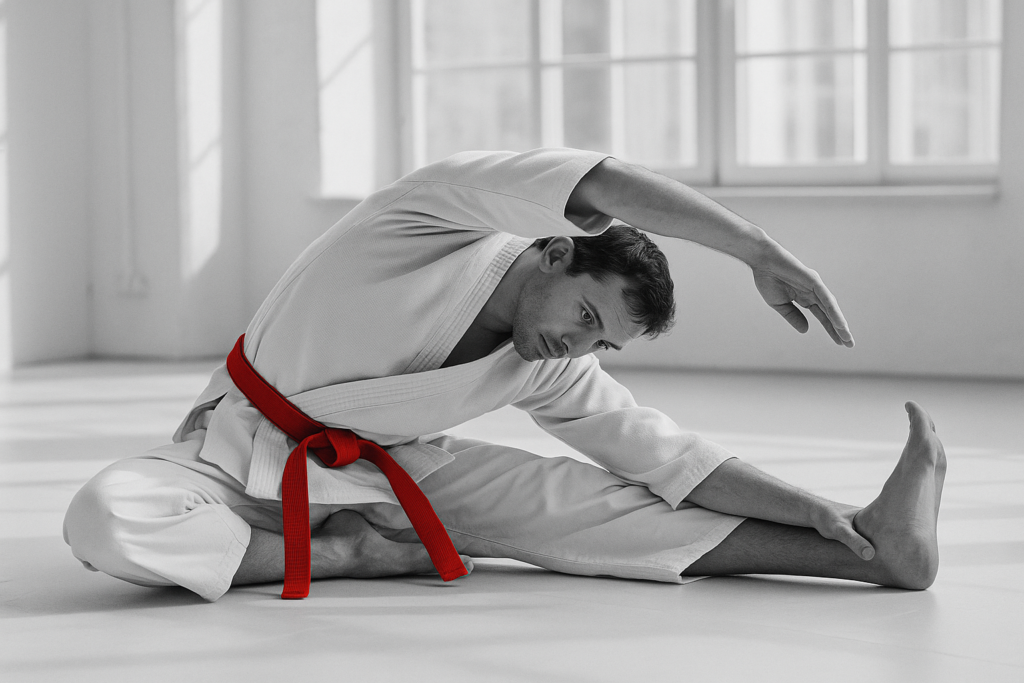
Mobility in Martial Arts Training: Sensible Rather Than Extreme
Mobility is a tool in martial arts training, not an end in itself. Anyone who wants to perform techniques cleanly needs a functional degree of mobility – not the splits as a status symbol. Sensible mobility training is oriented toward the demands of the respective martial art and the individual body, not toward extreme values.
Why Mobility Plays a Role in Martial Arts Training
Many techniques in martial arts training – whether kicks, throws or ground work – require a certain range of motion in the hips, shoulders and spine. If this mobility is lacking, it is often compensated for with imprecise technique or excessive force. This can impair movement quality and may have an unfavorable effect on joints and muscles.
Sufficient mobility can also help movements become more economical. A martial arts student who can freely rotate their hips, for example, needs to make fewer compensatory movements in the upper body when kicking. This is no guarantee against injury, but it can be one building block of sustainable, long-term-oriented training.
The distinction is important: mobility in the martial arts sense means developing the range of motion necessary for one’s own practice – not measuring oneself against artistic extremes. A values-oriented martial arts school usually conveys this distinction deliberately, while a purely commercial training operation without an educational framework sometimes neglects this aspect.
Exercises for Greater Mobility
Dynamic Warm-Up
Before actual practice, a dynamic warm-up is usually recommended: controlled movements such as leg swings, arm circles or lunges with rotation. These exercises prepare the joints and muscles for the load that follows and are often used at the beginning of a session in martial arts training.
Mobility Exercises for Hips and Shoulders
Since the hips and shoulders are central joints in many martial arts, targeted work on their mobility is worthwhile. These include, for example:
- Hip circles standing or on all fours
- Controlled rotation exercises for the shoulders
- Lunges with upper-body rotation
Such exercises can be integrated into training without losing focus on the actual technical work.
Static Stretching After Practice
Static stretching – that is, holding a stretch position for a longer period of time – is usually recommended toward the end of a session, once the muscles are already warm. It can help to gently expand the range of motion over time. Whether and to what extent static stretching is sensible immediately before intense exertion is judged differently by different sources.
Consistency Rather Than Intensity
For the development of mobility, the following usually applies in martial arts training: regular, moderate sessions are more effective than infrequent, intense sessions. A martial arts student tends to benefit more from short, recurring practice sequences than from occasional extreme sessions.
Common Mistakes in Dealing with Mobility
In the area of mobility and martial arts, similar mistakes keep occurring:
- Stretching without warming up: Anyone who stretches cold muscles intensively takes an unnecessary risk.
- Comparison with others: Mobility varies greatly from person to person. Comparing oneself with other students often leads to excessive demands on one’s own body.
- Ballistic stretching without preparation: Jerky, uncontrolled movements aimed at increasing range of motion carry a higher risk of injury than controlled methods.
- Ignoring pain signals: A pulling sensation is normal with some forms of stretching, but pain is a warning signal that should not be ignored.
- Lack of connection to one’s own martial art: Mobility work should be oriented toward the actual demands of the martial art being practiced, not toward isolated show elements.
A purely commercial training operation that treats mobility as a mere side issue or focuses solely on quick visible results is more likely to encourage these mistakes. In a martial arts school with clearly structured lessons, on the other hand, mobility work is usually embedded in a larger context of technique, body awareness and long-term development.
Safety in Mobility Training
Mobility work in martial arts training should generally proceed gently and step by step. Some principles have proven effective:
- Warming up before every more intense stretching or mobility session
- Pain-free practice – a slight pulling sensation is possible, pain is a stop signal
- Gradual increase in range of motion over weeks and months, not within individual sessions
- Individual adaptation to age, prior experience and physical conditions
- Guidance from an experienced instructor, especially for advanced stretching or mobility exercises
Existing health limitations, previous injuries or uncertainties should be clarified with a doctor or physiotherapist before beginning more intense mobility work. This text does not replace individual professional advice and does not constitute a health claim.
In summary: mobility is one supporting factor among several in martial arts training – alongside technique, strength, coordination and mental preparation. A martial arts student is well advised to understand mobility as a continuous, long-term process rather than a short-term goal to be achieved at any cost.