Which Martial Art Suits Which Child?
Key statement: There is no martial art that is universally “the right one” for a particular child – what matters is temperament, stage of development, and the goals that parents and child pursue together. More important than the name of the style is the quality of the instruction: Does the school place value on development, respect, and age-appropriate teaching, or is it purely a training operation without any educational concept? This guide offers initial orientation for parents who are considering martial arts for their children.
Why Choosing a Martial Art Is an Individual Matter
Children between four and twelve years old are at very different stages of development. A six-year-old has different motor and cognitive abilities than an eleven-year-old. Added to this are individual personality traits: some children are more reserved and seek structure, while others are eager to move and need space to burn off energy. There is no reliably established, universally valid rule of “this martial art style suits this character type” – corresponding assessments should be understood as tendencies, not as proven facts.
Club or Martial Arts School – An Important Difference
A pure club or classic training operation often focuses on athletic performance, competition, and technical instruction. A values-oriented martial arts school, on the other hand, understands teaching as a holistic process: alongside technique, respect, discipline, self-control, and the child’s personal development are at the center. For younger children, this difference can be crucial, since social and mental aspects are fostered alongside physical ones.
Overview: Different Martial Arts and Their Focus Areas
The following classifications are general tendencies and are no substitute for personally getting to know the instruction on site.
Judo
Judo places its focus on throwing and falling techniques as well as ground work. The close physical contact and the principle of yielding and counteracting can help children develop a sense of their own body and that of their partner. Judo is often recommended for children who enjoy learning through direct physical contact and take pleasure in playful tests of strength.
Karate
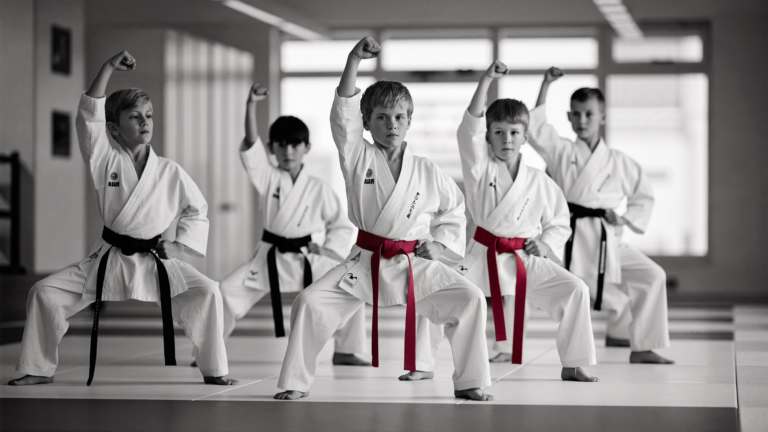
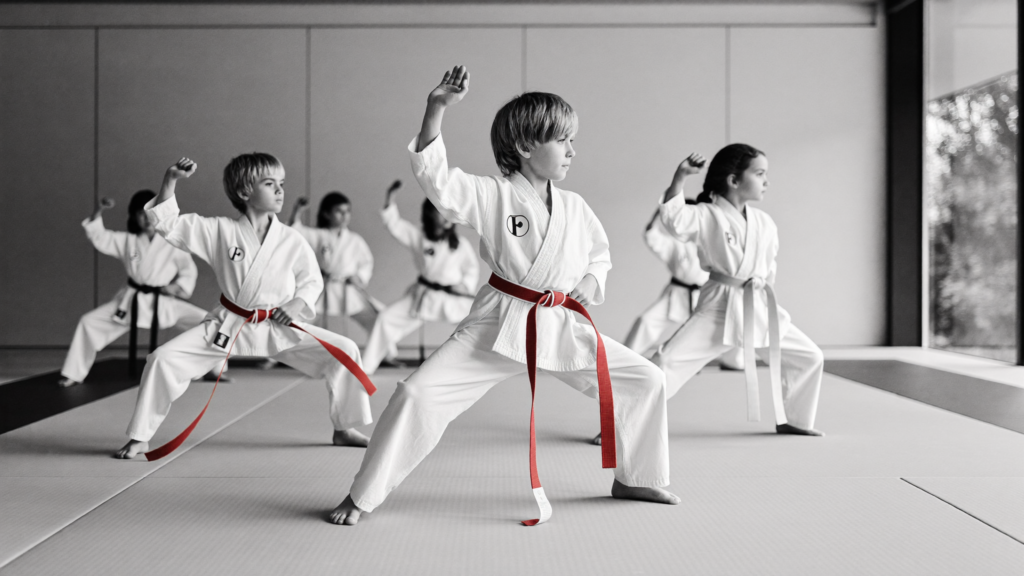
Karate works heavily with fixed movement sequences (kata), clear commands, and recurring exercise forms. Children who appreciate structure and repetition often find a good framework here. The high proportion of form training can also help more reserved children gradually get used to movement and group instruction.
Taekwondo
Taekwondo is known for its high proportion of kicking techniques and dynamic movements. Energetic children who enjoy moving can find a suitable outlet here. At the same time, good instruction also places value on concentration and self-control, since the technique can hardly be executed cleanly without these elements.
Kung Fu / Wushu
This umbrella term covers very different styles with flowing, sometimes complex movement sequences. Children with a good sense of movement and an interest in choreographic elements can be challenged here. The range of schools and styles is wide, which is why a close look at the respective concept is advisable.
Aikido
Aikido largely dispenses with strikes and kicks, working instead with joint locks, throws, and using the opponent’s own momentum. The style is often described as comparatively gentle and can be interesting for children who prefer cooperative rather than competitive forms of learning. Suitability for children depends strongly on the individual teacher and how the lessons are structured.
Wrestling
Wrestling focuses on ground work, control, and direct physical contact without striking techniques. Children with a lot of strength and a strong urge to move, who enjoy learning through immediate physical exchange, often find a suitable format here.
Criteria That Can Help With the Selection
- How does the child respond to fixed structures and repetition compared to freer forms of movement?
- Does the child seek close physical contact, or does he or she prefer distance from a partner?
- How pronounced is the urge to move – does the child need a lot of physical outlet, or rather calm concentration exercises?
- How does the child respond to group instruction and to directions given by the teacher?
- Which goals are in the foreground: self-confidence, concentration, social competence, physical fitness, or a combination of these?
Self-Defense: Prevention Before Technique
Many parents also associate martial arts with the wish that their child be better able to protect themselves in an emergency. However, serious instruction for children does not place physical techniques in the foreground, but rather prevention: recognizing and avoiding dangerous situations, confident behavior, and knowing when to get help or how to assert oneself verbally. Physical techniques are taught – if at all – only as a last resort, adapted to the situation. Martial arts instruction for children should make no promises of guaranteed “everyday safety,” but rather introduce the subject in an age-appropriate and responsible manner.
What Parents Can Look for in Instruction
- The teacher’s qualifications and pedagogical experience in working with children
- Group size and age mix within the children’s group
- Clearly recognizable values such as respect, fairness, and consideration in the lessons
- Transparent communication with parents about the content and goals of the instruction
- The opportunity to try out a class in advance before making a longer-term commitment
Conclusion
Martial arts for children can provide many positive impulses – for body control, concentration, and social behavior. However, which style is right in a given case cannot be derived solely from a list of character-type assignments; it often only becomes clear once the child directly experiences a specific class. More important than the choice between judo, karate, or taekwondo, therefore, is whether the respective school places value on values-oriented instruction and takes the individual child’s development seriously.